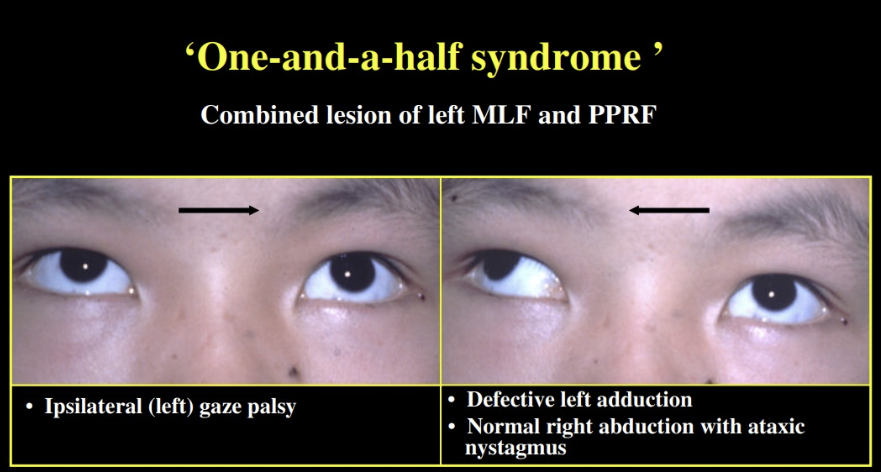
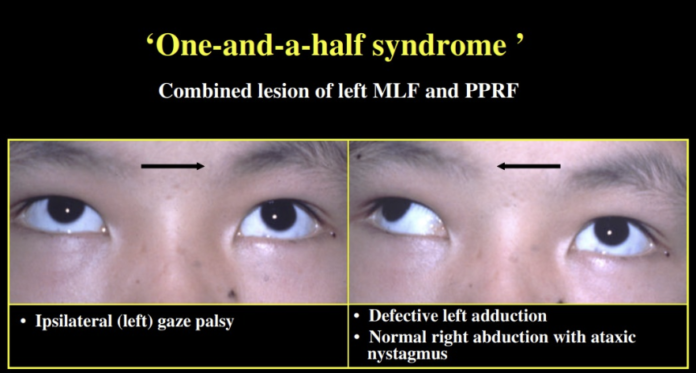
- 🧠 Lesion: PPRF / Abducens nucleus + ipsilateral MLF
- 👁️ Ipsilateral eye: no horizontal movement
- 👁️ Contralateral eye: abducts only (half movement) + nystagmus
- 🔼🔽 Vertical movement: preserved
- ⚡ Symptoms: diplopia, oscillopsia, balance issues
Optional: neuron/microstructure emphasis
- 🧠 Central pathway affected: MLF (internuclear fibers), PPRF (horizontal gaze center)
- ⚗️ Functional effect: horizontal gaze palsy + INO
- 👁️ Clinical hallmark: “one eye frozen, other eye half-moves”
Definition:
- One eye cannot move horizontally at all.
- The other eye can only move halfway horizontally.
🔹 Key Features
- Horizontal gaze palsy to the side of the lesion → one eye frozen
- Internuclear ophthalmoplegia (INO) on attempted gaze to opposite side:
- Adducting eye (same side as lesion) fails to cross midline
- Abducting eye (contralateral) shows nystagmus
- Vertical eye movements are preserved
- May cause diplopia, oscillopsia, balance problems
🔹 Pathophysiology
- MLF lesion: → internuclear ophthalmoplegia (INO)
- PPRF or abducens nucleus lesion: → horizontal gaze palsy
- Combination lesion: PPRF/abducens nucleus + MLF → One and a Half Syndrome
🔹 Summary Table
| Feature | Findings |
|---|---|
| Eye ipsilateral to lesion | Cannot move horizontally |
| Eye contralateral to lesion | Can only abduct (half movement), nystagmus present |
| Vertical movement | Preserved |
| Common symptoms | Diplopia, oscillopsia, balance issues |
| Lesion location | PPRF/abducens nucleus + ipsilateral MLF |
✅ Mnemonic for Recall:
“One eye frozen, other eye half-moves → think PPRF + MLF lesion”